
Does Your Home's Fire Protection Actually Work? Here's What Every Homeowner Should Know
A plain-language breakdown from a building science engineer
4/14/20264 min read
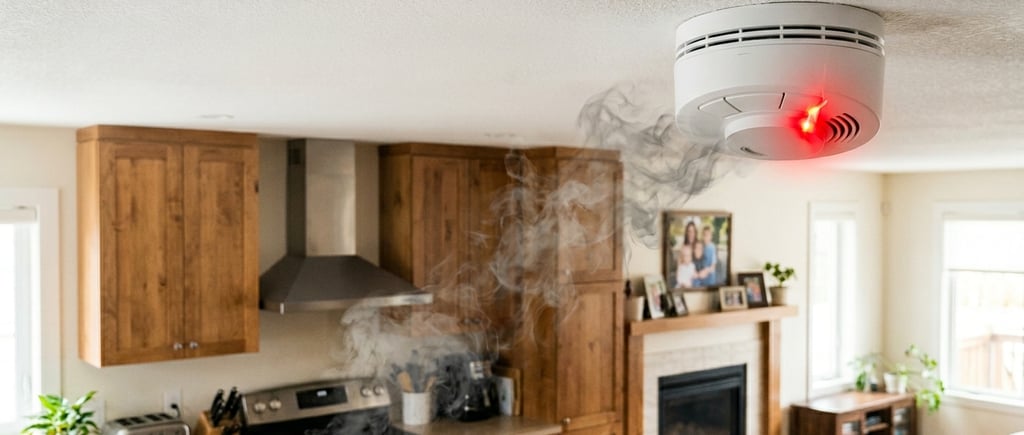
Most homeowners assume their fire protection is fine - until it isn't. The reality is that smoke alarms go untested for years, sprinkler systems (if you have one) get tampered with during renovations, and most people have no idea what to actually check or how often. This four part guide walks you through everything in plain language, no contractor required.
Part 1: Smoke Alarms vs. Fire Alarms: What's the Difference?
Most single family homes have smoke alarms, not a full fire alarm system. Here's the distinction:
A smoke alarm is a standalone device: It detects smoke and sounds locally. That's the disc on your ceiling. It only informs the people in your home. Smoke alarms can trigger without an actual fire. Steam from a shower, burnt toast, aerosol sprays, and even high humidity can set it off.
PRO TIP: To silence a nuisance alarm, Fan the area vigorously to clear smoke/steam or most units have a "hush" button that silences it for 8-10 minutes while you clear the air. Never remove the battery permanently as your fix. That's unfortunately very common and leaves you unprotected.
A fire alarm system is networked: It detects heat, smoke, or sprinkler activation and can automatically notify your monitoring company or fire department. This is more common in large buildings but is increasingly being installed in custom and luxury homes.
As an engineer, I recommend: If you're building new or doing a major renovation, ask your contractor about interconnected smoke alarms at minimum - when one goes off, they all go off. It's inexpensive at rough-in stage and could save your life.
Part 2: Do Single Family Homes Even Have Sprinklers?
Most older homes don't have sprinklers but this is changing. Many municipalities now require residential sprinkler systems in new construction. The Ontario Building Code changes that took effect April 1, 2010 require sprinklers in multi-unit residential buildings higher than three storeys. If your home (higher than three storeys) was built after 2011 in certain jurisdictions, you may already have one and not fully understand it. You may also choose to voluntarily install it for safety.
How a residential sprinkler actually works:
It is not like the movies. All sprinklers do not go off at once. Each sprinkler head activates individually when the heat directly above it reaches a threshold, typically around 135–165°F (57–74°C). It responds to heat, not smoke. One head activating releases enough water to control most residential fires before the fire department arrives.
The components you should know exist in your home:
Main control valve — shuts off water to the entire sprinkler system. Usually near your water main or in a utility room. Should always be in the open/on position unless you're doing maintenance.
Inspector's test valve — allows a plumber or inspector to test system flow without triggering all heads.
Flow alarm — triggers when water moves through the system, alerting your monitoring company.
Sprinkler heads — the visible part on your ceiling. Should never be painted over, blocked by storage, or have anything hanging from them.
Part 3: What to Actually Check as a Homeowner
Smoke alarms — monthly: Press and hold the test button until the alarm sounds. If it's weak or delayed, replace the battery. If it's hardwired and still weak, the unit may need replacing.
Smoke alarm placement check — annually: Every bedroom, outside each sleeping area, and on every level including the basement. If yours don't match this layout, you have a gap.
Smoke alarm age — every 10 years: There's a manufacture date on the back. Most homeowners don't know their alarms are expired. Check yours today.
Carbon monoxide detectors: (Not a fire device but worth mentioning here) Required within 15 feet of sleeping areas in most Canadian and US jurisdictions. Often overlooked entirely.
Sprinkler system (if you have one):
Walk your home quarterly and visually inspect every sprinkler head. Look for corrosion, paint, physical damage, or anything hanging from or blocking the head.
Check your main control valve is fully open.
Have a licensed sprinkler contractor perform an annual inspection. This is NOT optional if you have a monitored system, and is strongly recommended regardless.
Never, ever paint over a sprinkler head. It compromises the thermal element and the head will not activate properly. This happens constantly during DIY renovations.
After any renovation: If a contractor worked near your ceiling - drywall, painting, HVAC - do a full visual check of every alarm and sprinkler head in the affected area before closing the space up.
By law, every home in Ontario must have a working smoke alarm on every storey and outside all sleeping areas. It is the homeowner's responsibility to install and maintain them. This has been the law since March 1, 2006 and covers single family, semi-detached, and town homes whether owner-occupied or rented. If your home was built after January 1, 2015 or is undergoing major renovations, all required alarms must include a built-in strobe light for accessibility compliance under the Ontario Building Code. Failure to comply can result in a $360 ticket or a fine of up to $50,000 for individuals.
Part 4: When to Call an Engineer (Not Just a Contractor)
Most homeowners call a plumber or fire protection contractor and trust whatever they're told. That works most of the time; but here's when a second, independent opinion is worth it:
You're buying a home with an existing sprinkler system and the inspection report is vague
A contractor tells you the sprinkler system needs full replacement and you want to validate that
You're doing a major renovation and aren't sure how it affects your fire protection coverage
Your insurance company is asking questions about your system you can't answer
An engineer acts as your advocate here - we review documentation, ask the right questions, and have no financial interest in selling you a new system.
The Bottom Line
Fire protection in a single family home is low maintenance but not zero maintenance. The biggest risk isn't a faulty system, it's a system that's been quietly compromised by years of neglect, bad renovations, or expired equipment that nobody checked.
Ten minutes of your time today is worth it.
Questions about your home's systems? This is exactly where we help homeowners navigate, reach out below.
Contact
Reach out for expert project guidance
Phone
+1 647-819-5325
© 2025. All rights reserved.