
Asphalt vs. Rubber Driveways: Why Smart Homeowners Are Making the Switch
Your driveway endures more abuse than almost any surface on your property. The material you choose now will determine how safe, durable, and costly your driveway is for the next 20+ years - especially through Canadian winters.
4/26/20263 min read
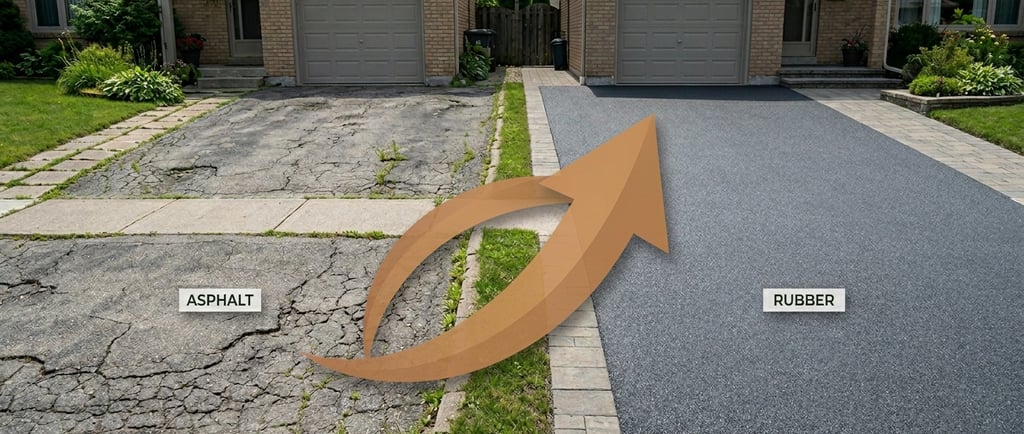
If you're a homeowner evaluating your driveway options, you've almost certainly heard of traditional asphalt. It's been the go-to for decades: affordable upfront, widely available, and familiar. But a newer contender has been quietly gaining ground: rubber driveways, made from recycled tire material. The gap between the two isn't just about price. It's about what you're willing to deal with over the long haul.
Let's break it down honestly.
The truth about asphalt
Asphalt has earned its reputation for a reason. It's relatively quick to install, costs less upfront, and contractors who can install it are everywhere. For decades, it was simply the practical choice.
But asphalt has a fundamental weakness: it's rigid and petroleum-based. That means it expands in summer heat, contracts in winter cold, and over time, those cycles cause cracks. Once cracks appear, water seeps in, freezes, expands, and the damage accelerates. In climates with harsh winters - like much of Canada - this cycle is relentless.
You'll also need to sealcoat asphalt every three to five years to prevent UV degradation and water intrusion. That's ongoing cost and hassle. And when asphalt gets icy? It's among the most treacherous surfaces you can walk or drive on.
"Most homeowners don't realize how much they'll spend on asphalt maintenance over 15 years - resealing, patching cracks, and eventually full replacement can match or exceed the original installation cost."
Why rubber driveways cost more - and why that's worth it
Rubber driveways are manufactured from recycled vehicle tires, ground into granules, mixed with a binding agent, and installed either as interlocking tiles or as a poured surface. The material itself is more expensive to produce and requires skilled installation. That's why the sticker price is higher.
But here's the long-term math that changes the conversation:
Rubber driveways have a lifespan of 20 to 30 years or more with very little upkeep. No sealing. No patching. No repainting. The material is inherently flexible, so freeze-thaw cycles that destroy asphalt simply don't affect rubber the same way. It expands and contracts without cracking.
Ice, winter safety, and traction - where rubber truly shines
If you live anywhere that gets real winters, this section matters most. Asphalt driveways become genuinely dangerous surfaces when ice forms. The smooth, hard surface offers almost no grip — for feet or for tires.
Rubber driveways behave fundamentally differently in winter:
Natural grip texture. The granular surface of a rubber driveway provides significantly more traction than asphalt, even when wet or lightly frosted. That's the same science behind rubber-soled winter boots.
Slower ice formation. Rubber is a natural insulator. Unlike asphalt, which conducts cold rapidly and allows ice to bond tightly to the surface, rubber's thermal properties slow ice adhesion and can reduce how much ice actually forms.
Easier ice removal. When ice does form, it doesn't bond to rubber the way it bonds to asphalt. That means less force needed to chip or shovel it away, saving your back — and your shovel.
Slip-and-fall protection. For families with children or elderly relatives, the cushioned, high-grip surface dramatically reduces the risk of a dangerous slip. This isn't a minor benefit — it's a genuine safety upgrade for your home.
No freeze-thaw cracking. The freeze-thaw cycle that is asphalt's greatest enemy has almost no effect on rubber. The material flexes with temperature changes rather than fracturing under them.
Other advantages worth knowing
Beyond winter safety, rubber driveways offer several other benefits that homeowners often discover after installation:
It's quieter. Rubber absorbs sound rather than reflecting it. Vehicles rolling in and out of your driveway will be noticeably quieter — a real perk in neighborhoods where noise matters.
It's easier on knees and backs. The slight give of a rubber surface is genuinely kinder on joints during long shoveling sessions or when kids are playing. It's also more forgiving if someone does stumble.
It's made from recycled material. Most rubber driveways repurpose tires that would otherwise end up in landfills. If sustainability matters to your household, this is a meaningful advantage.
Colours and finishes are available. Unlike black asphalt, rubber driveways come in a variety of colours and textures, giving you more control over your home's curb appeal.
So who should choose rubber?
Rubber driveways make the most sense for homeowners who plan to stay in their home for many years, who deal with serious winter conditions, who have elderly family members or young children at home, or who are frustrated by the ongoing maintenance cycle of asphalt.
Asphalt still has a place - if your budget is constrained right now, or you're planning to sell in the next few years, it remains a functional and widely accepted option.
But if you're thinking long-term about safety, durability, and total cost of ownership? The rubber driveway wins - and it isn't particularly close.
Not sure which option makes sense for your specific property, budget, or situation? That's exactly what we're here for. We work as your engineer and owner's representative - not as a contractor trying to sell you a product. Our only interest is helping you make the right call for your home. Connect with us below!
Contact
Reach out for expert project guidance
Phone
+1 647-819-5325
© 2025. All rights reserved.